Regional Recipe
Pane di Altamura Style Loaf
Durum semolina loaf in the Altamura style
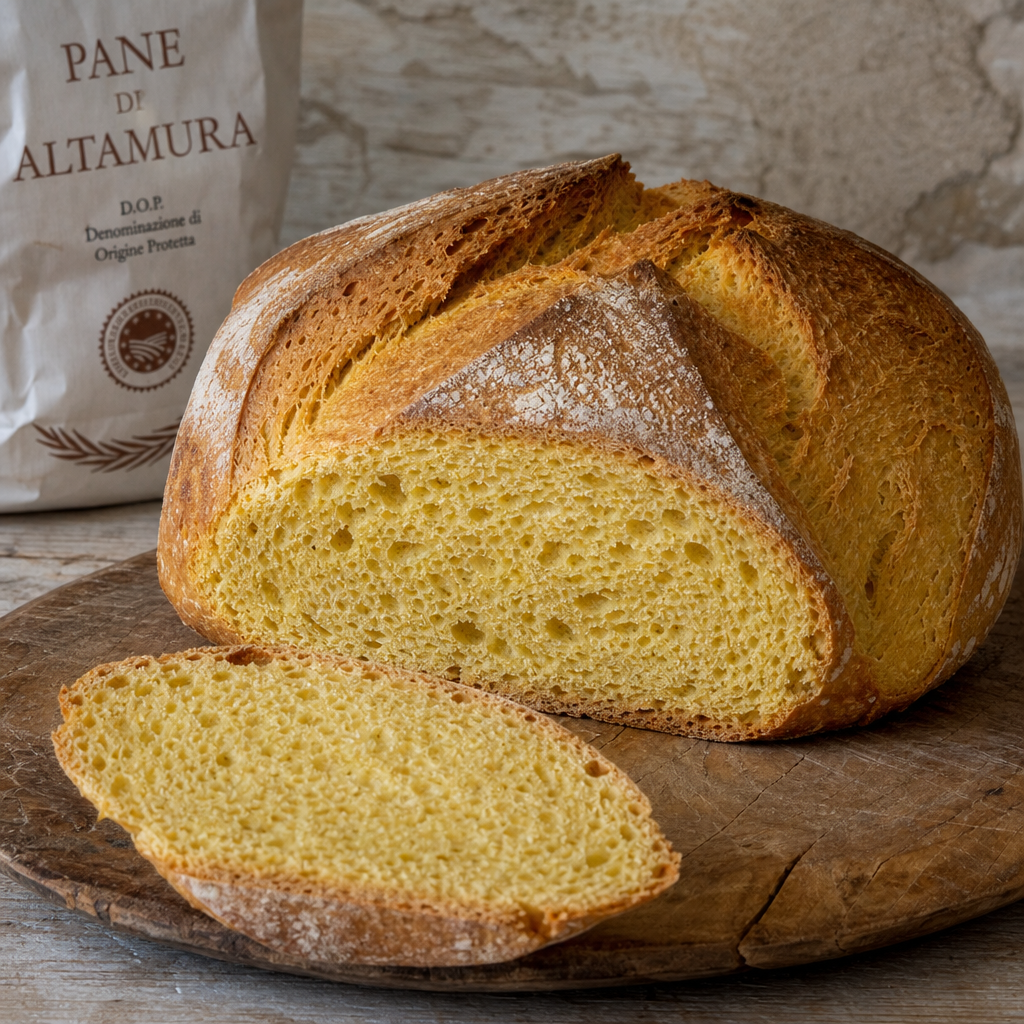
This is a durum semolina loaf with a golden crumb, made at home after the documented Altamura method.
Tested and written by Erika A. Cochran
Saved recipes live in the bookmark icon at the top of the page, on this device.
Prep
40 minutes, plus 8–10 hours rising
Cook
1 hour
Serves
1 large loaf (PDO loaves weigh at least 0.5 kg)
Difficulty
Advanced
Region
Altamura, Puglia
What you’ll need
Ingredients
Written for 1 large loaf (PDO loaves weigh at least 0.5 kg).
Showing quantities at 1× the original recipe.
- 4¾ cups remilled durum semolina (semola rimacinata)
- 5⅔ oz active natural starter
- 2 cups water
- 2⅔ tsp sea salt
At the stove
Instructions
Refresh your starter with semolina and water so it is lively before you begin.
Mix the semolina, water and starter for about 20 minutes, then cover and rest for at least 90 minutes.
Weigh and hand-shape the dough, rest 30 minutes, reshape and rest at least 15 minutes more.
For the taller u sckuanéte form, fold one side of the round over itself; for a cappidde de prévete, leave it low and wide.
Bake at about 480°F. Give it 15 minutes with steam, then 45 minutes more, until the crust is dark and at least ⅛ inch thick.
Vent the oven for the last minutes, then cool the loaf completely before cutting.
Recipe notes
A home adaptation. The PDO specification calls for at least 80% of the semolina from the designated territory — Appulo, Arcangelo, Duilio and Simeto varieties — and its ratio is 120 cups starter, 12 cups sea salt and about 254 cups water per 599 cups semolina.
Sold PDO loaves must weigh at least 1⅛ lb and take one of two sanctioned shapes.
Provenance confidence: very high, based on the EU register and the Italian Ministry specification.
Context
Pane di Altamura has held PDO status since 19 July 2003, covering Altamura, Gravina di Puglia, Poggiorsini, Spinazzola and Minervino Murge in north-western Murgia. The Ministry specification dates the bread to the sixteenth century and records a social baking system: large household doughs were finished in public ovens, marked by the baker with the family head's initials before loading. Its keeping quality fed farmers and shepherds for a week, and sometimes across the fifteen-day stretches spent in scattered farmsteads, on meals of bread, salt, oil and boiling water.
Sources: European Commission eAmbrosia — Pane di Altamura PDO: (opens in a new tab); Italian Ministry of Agriculture — Pane di Altamura PDO production specification; Consorzio Pane di Altamura DOP — Fasi della lavorazione: (opens in a new tab); Home adaptation by Casa Magnelli Kitchen
Keep cooking